



Climbing Mount Everest (8,849 m) in Nepal – Himalayas
60000,00 € Le prix initial était : 60000,00 €.43000,00 €Le prix actuel est : 43000,00 €.
📆 [March to May]
Who has never dreamed of climbing the world’s highest peak, Mount Everest, reaching an altitude of 8,848 meters? The ascent via the Nepalese side, considered the most accessible route, is the dream of a lifetime for many mountaineers.
Located on the border between the Sagarmatha region in Nepal and Tibet in China, Everest is part of the majestic Himalayan mountain range. The itinerary we offer is specifically designed to optimize acclimatization, a crucial and decisive phase of the climb. It is supervised by experienced Nepalese mountain professionals, ensuring safe and continuous guidance throughout the expedition.
Mount Everest
8,848 m
Khumbu · Everest Base Camp · Khumbu Icefall · 64 days
Sagarmatha — "Forehead of the Sky" in Nepali. Mount Everest is the highest mountain in the world and the ultimate goal of every mountaineer. An extraordinary expedition that demands years of preparation, flawless technical mastery, and unwavering mental resilience.
The expedition in brief
Mount Everest (8,848 m), or Sagarmatha in Nepali, is Nepal's greatest pride and the most coveted summit on Earth. Its iconic silhouette has dominated the Himalaya for millions of years — and since 1953, it has challenged the mountaineers who dare to attempt it. Climbing Everest is not merely an athletic feat: it is a profound transformation, an adventure that changes a life.
This 64-day expedition follows the classic South Side route, from Kathmandu to the roof of the world, via Base Camp (5,364 m), the Khumbu Icefall, and four high-altitude camps. You will be accompanied by certified UIAGM/IFMGA guides with a 1:1 sherpa ratio on summit day, and benefit from the Summit Oxygen system with 7 oxygen bottles included.
Highlights
Altitude profile
Technical requirements
Everest is an elite mountain that demands total mastery of high-altitude technical mountaineering. The Khumbu Icefall, the Western Cwm, the Lhotse Face, and the summit ridge are extreme passages within the death zone (above 8,000 m), where the body can no longer recover.
Day-by-day program
Day 1
Arrival in Kathmandu (1,300 m)
★★★★ Hotel Thamel — half board
Welcome at Tribhuvan International Airport. Transfer to the hotel, rest, welcome briefing, and introductory dinner with the Outwild team and your UIAGM guide.
Days 2–3
Kathmandu — Administrative preparation
★★★★ Hotel — B&B
Obtaining all official permits (Everest climbing permit, TIMS, Sagarmatha National Park). Intensive technical briefing with your guide, thorough check of high-altitude equipment. Free time to visit Boudhanath, Pashupatinath, and Durbar Square.
Day 4
Flight Kathmandu → Lukla (2,840 m) — Trek to Phakding (2,610 m)
↑ 400 m · 35-min flight + 2–3h walk · Lodge
Scenic 35-minute flight over the Himalayan giants to Lukla airport. Trek begins along the Dudh Koshi river. First views of Nupla (5,885 m) and Kusum Khangkaru (6,367 m).
Day 5
Phakding → Namche Bazaar (3,440 m)
↑ 830 m · 5–6h walk · Lodge
Passing through Monjo, the gateway to Sagarmatha National Park. Crossing suspension bridges over the Dudh Koshi, through pine and rhododendron forest. Arrival in Namche, the Sherpa capital of the Khumbu.
Day 6
Namche Bazaar — Acclimatization day
Active rest · Lodge
Morning hike to Khumjung or the Everest View Hotel (3,880 m). Exceptional views of Ama Dablam (6,856 m), Thamserku (6,608 m), Nuptse, Lhotse, and Everest itself. Discovery of the local Sherpa market.
Day 7
Namche → Tengboche (3,860 m)
↑ 420 m · 5–6h walk · Lodge
Crossing through Khumjung and Sanasa. Arrival in Tengboche and visit to its famous monastery, the most renowned in the Khumbu — a breathtaking viewpoint over Everest, Ama Dablam, and dozens of peaks.
Day 8
Tengboche → Dingboche (4,240 m)
↑ 380 m · 5–6h walk · Lodge
Descent toward Debuche along the Imja Khola, then climb to Pangboche and its ancestral monastery. Arrival in Dingboche, at the confluence of the valleys leading to Lhotse and Chhukung.
Day 9
Dingboche → Lobuche (4,940 m)
↑ 700 m · 5–6h walk · Lodge
Climb to the Dughla pass (4,830 m) and its memorial chortens for fallen mountaineers. Views of the Khumbu Glacier, Lobuche Peak, and the walls of Nuptse. The last inhabited villages before base camp.
Day 10
Lobuche — Acclimatization
Active rest · Lodge
An essential day at 4,940 m. Short hike to the Italian Pyramid observatory laboratory. Views of Lobuche East (6,119 m), Nuptse (7,861 m), and Lhotse (8,414 m). Mental and physical preparation.
Day 11
Lobuche → Gorak Shep (5,150 m)
↑ 210 m · 4–5h walk · Lodge
Crossing the Changri Glacier. Views of Nuptse (7,861 m) and Pumori (7,165 m). Gorak Shep, the last village before base camp, sits at 5,150 m — every step is felt.
Day 12
Gorak Shep → Everest Base Camp (5,364 m)
↑ 214 m · 5–6h · Tent (base camp)
The defining moment of the expedition: arrival at the most famous base camp in mountaineering. Walking across the moraine of the Khumbu Glacier to the tents of ongoing expeditions. First sight of the Khumbu Icefall.
Days 13–14
Setting up and organizing base camp
Base camp — Tents
Full setup of base camp (heated dining tent, kitchen, shower, toilet, generator). Detailed introduction to the climbing sherpas. Final check of equipment, Summit Oxygen bottles, and communication systems.
Days 15–57 — THE ASCENT
Progressive ascent of Mount Everest (8,848 m)
C1 (6,065 m) · C2 (6,750 m) · C3 (7,100 m) · C4 — South Col (7,920 m) · Summit (8,848 m)
The climbing phase is structured into several acclimatization rotations over 6 weeks. Each rotation climbs higher and returns to base camp to allow the body to adapt. The Khumbu Icefall is crossed with the Icefall Doctors on every rotation. The final push departs from Camp IV (South Col, 7,920 m) at night: the southeast ridge, the Hillary Step area, the South Summit traverse, and the summit ridge. From the top: a 360° view of the Himalaya — Lhotse, Makalu, Cho Oyu, Kangchenjunga, and hundreds of peaks on the horizon. Two summit attempt windows are planned to maximize the chances of success.
Day 58
Descent from base camp → Dingboche (4,410 m)
Lodge
Dismantling of base camp, waste transport (return transport included). Descent to Dingboche via Lobuche and the Dughla pass. The euphoria of descending and the first big meals.
Days 59–60
Dingboche → Namche Bazaar (3,440 m)
↓ 1,000 m · 6–7h walk · Lodge
Gradual return through Pangboche, Tengboche, and Phunki Tenga. Vegetation reappears, warmth returns — descending in altitude is a physical rebirth after weeks above 5,000 m.
Day 61
Namche Bazaar → Lukla (2,840 m)
↓ 600 m · 5–6h walk · Lodge
Final trekking leg through Monjo and Phakding. Rhododendron forests, suspension bridges, and waterfalls — a return to nature after the ice of high altitude. Evening celebration in Lukla.
Day 62
Flight Lukla → Kathmandu + free day
★★★★ Hotel — B&B
Scenic return flight to Kathmandu. Transfer to the hotel. Recovery day — exploring Thamel, wellness treatments, souvenir shopping. Legs finally come down from the Himalaya.
Day 63
Kathmandu — Sightseeing & farewell dinner
★★★★ Hotel — B&B
Local guide for the UNESCO sites: Pashupatinath, Durbar Square, Boudhanath Stupa, Swayambhunath Temple. Evening: farewell dinner at a traditional Nepali restaurant with a cultural show — an Outwild tradition.
Day 64
International departure
Airport transfer included
Transfer to Tribhuvan International Airport according to your flight schedule. End of Outwild services — but the beginning of your new life as an Everester.
From the summit: five 8,000ers on the horizon
From the 8,848 m of Mount Everest, you will gaze upon Lhotse, Makalu, Cho Oyu, Kangchenjunga, and hundreds of Himalayan peaks — the greatest panorama a human being can reach on foot.
What's included
✓ Included in the price
- ✓4 nights in a ★★★★ hotel in Kathmandu (breakfast included)
- ✓Certified UIAGM/IFMGA/NNMGA high-mountain guide
- ✓Domestic flights Kathmandu ↔ Lukla (climber + team)
- ✓Full base camp setup: heated dining tent, kitchen, shower, toilet
- ✓Individual tents at base camp, shared at C1/C2/C3/C4
- ✓High-altitude generator + solar panel (6 weeks before the expedition)
- ✓Full board throughout (B&B only in Kathmandu)
- ✓High-altitude camp equipment (tents, stove, gas, cookware, food)
- ✓Summit Oxygen system: mask, regulator + 7 bottles per participant
- ✓Emergency oxygen at base camp
- ✓High-altitude porters + climbing Sherpa (1:1 ratio on summit day)
- ✓Icefall Doctors fees for the Khumbu Icefall route
- ✓All fixing equipment + fixed ropes along the entire route
- ✓Luggage transport to base camp and back (40 kg per participant)
- ✓Everest climbing permit + TIMS + Sagarmatha National Park + all permits
- ✓Government liaison officer
- ✓High-altitude medical kit, pulse oximeter, emergency pharmacy
- ✓Emergency satellite communication + radio per participant
- ✓Insurance and equipment for all Nepali staff
- ✓Return transport of waste from base camp
- ✓Daily weather forecasts
- ✓Farewell dinner with Nepali cultural show
- ✓Round-trip airport transfers (domestic & international)
- ✓All Nepali government taxes
✗ Not included
- ✗Round-trip international flights
- ✗Travel insurance & helicopter evacuation/repatriation (mandatory)
- ✗Personal climber's insurance
- ✗Nepal visa (available at the airport — bring a passport photo)
- ✗Lunches and dinners in Kathmandu (except the farewell dinner)
- ✗Personal climbing gear (harness, 12-point crampons, ice axe…)
- ✗High-altitude down suit & -40°C sleeping bag
- ✗Shipping fees for generator and high-altitude tent from outside the EU
- ✗Summit bonus for personal sherpas (min. $500 above C4)
- ✗Personal communications: satellite phone, email, internet
- ✗Personal medical expenses & helicopter evacuation of the climber
- ✗Personal medication (Diamox, Dexamethasone…)
- ✗Cold & alcoholic beverages, personal expenses
- ✗Tips, souvenirs, gifts
- ✗Helicopter flight base camp → Kathmandu (on request)
Ready for the roof of the world?
Outwild connects you directly with certified UIAGM guides · Groups & individuals · Custom expeditions available
| Altitude | 8,000 meters |
|---|
⛰ Everest · 8,849 m · Nepal
Preparing for Everest
Climbing the roof of the world is not simply a matter of willpower. It is 12 to 24 months of preparation, a profound physical and mental transformation, and an intimate understanding of how your body responds to extreme altitude. What follows is not a generic program: it is the reality of an expedition above 8,000 meters.
🏋️ Physical preparation: the foundation of everything
Everest demands a level of physical fitness that few mountaineers truly reach before setting off. Beyond the elevation gain (roughly 3,500 m between advanced base camp and the summit, partly under oxygen), it's the duration of repeated effort — often 12 to 16 hours a day during the final rotations — that breaks down bodies that aren't sufficiently prepared. Training is structured around three pillars.
❤️ Cardio endurance
Uphill running, cycling, cross-country skiing. The goal: reach a VO₂max above 55 ml/kg/min and sustain 6–8 hours of continuous effort at 70–75% of max heart rate. Long weekly outings of 5 to 7 hours in mountainous terrain.
💪 Functional strength
Legs (loaded squats, lunges, step-ups with a 20–25 kg pack), deep core work, shoulders and back for handling fixed ropes. Stabilizing muscles work to exhaustion at very high altitude.
🎒 Mountain-specific training
Extended hikes with a 20 to 30 kg pack on steep terrain. Sessions with crampons, jumar on fixed rope, progression on ice. Train with the exact equipment planned for the expedition.
📅 Month-by-month training plan
For an April–May expedition (the classic spring window), here is an 18-month plan starting in October of the previous year. This plan assumes an already active mountaineer with an existing aerobic base.
🔄 Everest-specific acclimatization and rotations
Everest is climbed according to a precise acclimatization protocol, dictating the back-and-forth movements between base camp (5,364 m) and the upper camps before the final attempt. This protocol isn't a suggestion: it's what separates those who reach the summit from those who turn back in an emergency.
🧠 Mental preparation: the invisible factor that decides everything
🎯 Managing uncertainty
Accepting that 60 days of expedition mean entire days of doing nothing, cancelled weather windows, and difficult decisions to turn back. Mental resilience to waiting is just as crucial as physical endurance.
🔁 Visualization and grounding
A technique used by elite mountaineers: visualizing the technical sections step by step (the Balcony, Hillary Step, summit ridge), the sensations of cold, fatigue, and breathlessness — and preparing for them emotionally.
⚖️ Making the decision to turn back
Most accidents happen on the descent, often because the climber couldn't or wouldn't turn back in time. Set objective criteria before departure: a hard turnaround time at the Hillary Step (1 pm at the latest), and warning signs that must never be ignored.
🫁 Managing prolonged discomfort
Between C4 and the summit, every step at 8,800 m requires 5 to 8 full breaths. Muscle pain, cold (-30 to -40°C with real wind), and sleep deprivation — all of this must be worked through mentally beforehand, not on the mountain.
🌤 Weather conditions and the ideal window
Everest is attempted twice a year: pre-monsoon (April–May) and post-monsoon (September–October). The spring window is by far the busiest, with a typical favorable period between May 15 and May 25 — often narrowed to just 3–5 usable days.
🌸 Pre-monsoon (Apr–May) — main window
- Summit temperatures: -20 to -35°C (night)
- Jet-stream winds: 80–150 km/h in April, weakening in May
- Stable window: 3–10 days maximum, not guaranteed
- Better visibility, more climbing teams (fixed-rope traffic)
- Khumbu Icefall: active but manageable before the June warm-up
🍂 Post-monsoon (Sep–Oct) — secondary window
- Lower temperatures: -30 to -45°C with wind chill
- Fewer teams, less competition for fixed ropes
- Heavier fresh snow, increased avalanche risk
- Short window: late September – mid-October
- Reduced logistics and support (fewer sherpas available)
⚠️ Objective hazards specific to Everest
⏱ Fatigue management and ascent pace
The most counterintuitive rule of Everest: go slower than you think you're capable of. Perceived effort at 8,000 m corresponds to maximal effort in the valley — and a climber who "feels fine" can collapse 200 m higher if they haven't managed their pace.
🔋 High-altitude nutrition
Appetite almost completely disappears above 7,000 m. Force fast-acting carbohydrates (gels, bars, hot soup) every 45–60 minutes. Hydration: a minimum of 4 to 5 L/day. Reduce fat intake in favor of carbohydrates beyond C3.
😴 Sleep and recovery between rotations
Sleep at base camp (5,364 m) remains restorative. Descending to Dingboche (4,410 m) or Namche (3,440 m) is recommended between rotations to maximize recovery — lower altitude accelerates blood regeneration.
🎒 Essential tips before leaving home
⛰ Everest · 8,849 m · Nepal
What level is needed to climb Everest
Everest isn't reserved for superhumans, but it isn't for everyone either. This section helps you honestly assess whether you're ready — and if you're not quite there yet, what path will get you there. Because leaving too soon puts your life and your team's at risk.
👤 Three climber profiles facing Everest
There is no single type of Everest candidate. Depending on your background, your relationship with altitude, and your technical abilities, you'll recognize yourself in one of these three profiles — each with its own reality and specific requirements.
The seasoned high-altitude mountaineer
This profile can apply for a guided ascent with supplemental oxygen. Success still depends on weather, acclimatization, and on-the-ground decision-making.
The progressing 6,000 m mountaineer
⚠️ Outwild recommendation: 1 to 2 intermediate expeditions before Everest (Baruntse 7,129 m, Mera Peak + Island Peak back-to-back, or Cho Oyu 8,188 m as a first 8,000er).
The expedition mountaineer climbing without oxygen
This profile may consider an attempt without supplemental oxygen. This applies to fewer than 3% of climbers who reach the summit each year.
🗺 Recommended summits before Everest
Climbing Everest is not something you improvise after a few high-altitude hikes. Here is the progressive path we recommend at Outwild, from your first snow summit to the roof of the world. Each step builds a specific, irreplaceable skill.
🧗 Essential technical skills
Everest is not technical climbing in the alpinist sense of the word — there's no 7a+ pitch or major vertical wall. But the required skills are precise, non-negotiable, and must be fully automatic, because at 8,500 m under severe hypoxia, the brain is no longer capable of learning.
🪝 Jumar and fixed ropes
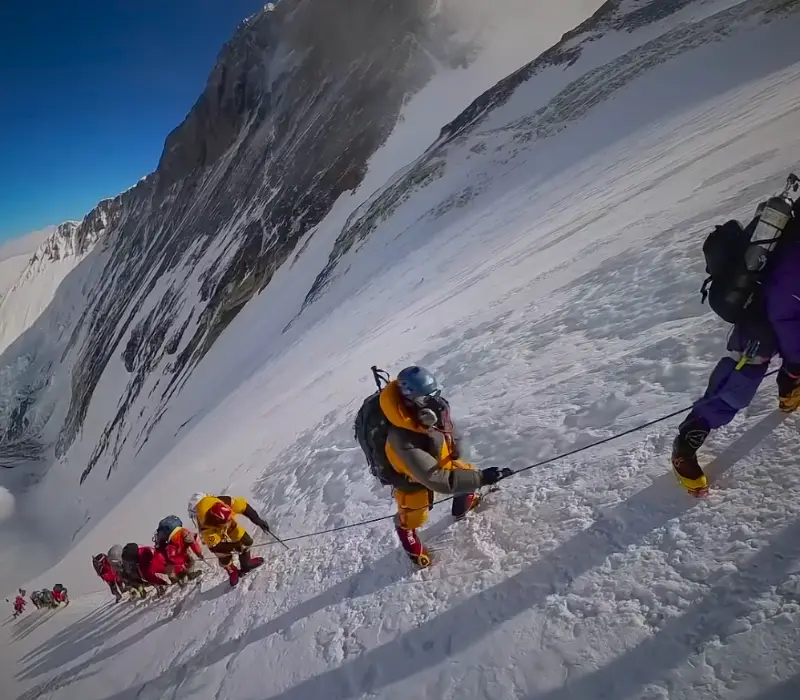
Nearly the entire climb from C1 to the summit is done on fixed ropes installed by the lead sherpas. Mastery of the jumar (locking, transferring, passing anchor knots) on steep terrain, with crampons, thick gloves, and an oxygen mask, must be instinctive. Hundreds of repetitions are required.
🧊 Ice and snow techniques
Moving on 40–55° slopes (the Lhotse Face between C2 and C3), front-pointing with crampons, using an ice axe for anchoring and self-belay. The Khumbu Icefall adds ladder crossings over ice bridges — a technique that absolutely must be practiced before departure.
🫁 Managing O₂ equipment
Swapping a bottle at -30°C while wearing high-altitude gloves, adjusting the flow rate (1 to 4 L/min depending on the phase), diagnosing a regulator leak. These actions must be doable blind — because they sometimes happen in total darkness at 8,700 m.
⛺ Setting up a tent in extreme conditions
Ability to set up or repair a high-altitude tent in 60 km/h winds and -25°C. Managing a night at C4 on a narrow ledge of the South Col (7,950 m), wearing high-altitude boots, in a 60 cm space — without losing any gear over the edge.
🚑 High-altitude first aid
Recognizing pulmonary edema (HAPE) or cerebral edema (HACE) in yourself or a teammate. Deciding on immediate evacuation, administering dexamethasone or nifedipine. Using a Gamow bag if available. WFR (Wilderness First Responder) training strongly recommended.
🔦 Night travel
The push from the South Col starts between 8 pm and 10 pm to reach the summit before 10 am. Several hours of travel on snow and rock in total darkness, with a headlamp, oxygen mask, and gusting wind. Nighttime disorientation at high altitude is a real risk.
🥶 Managing cold and altitude: what your body needs to be able to do
❄️ Cold as the limiting factor
At the South Col (7,950 m), nighttime temperatures range from -25 to -35°C. With the katabatic wind flowing down from the summit, the wind chill can exceed -50°C. Frostbite to the toes or fingers, even partial, can occur in under 30 minutes with compromised circulation. Intimate knowledge of your own thermal limits — tested under real conditions before the expedition — is essential.
🧬 Natural acclimatizer vs. poor acclimatizer
Some bodies produce more erythropoietin (natural EPO) in response to hypoxia, maintaining adequate O₂ saturation even at very high altitude. Others drop quickly below 70% as early as 7,000 m — a sign of high risk further up. The essential test: measure your saturation after a night at 5,000 m and then at 6,000 m during acclimatization. If it's below 80% in the morning at 5,400 m, a medical consultation is required before considering going higher.
⚡ Common mistakes made by Everest candidates
🚫 Who this expedition is not suited for — our honest opinion
At Outwild, we refuse to sell a dream to someone whose life would be at risk. Here are the profiles for which we strongly advise against attempting Everest, at least in the short term.
⛰ Everest · 8,849 m · Nepal
Oxygen on Everest: Everything You Need to Understand
At 8,849 m, every breath contains only 33% of the oxygen available at sea level. Without supplemental oxygen, most human bodies reach their absolute physiological limit — and many never make it to the summit. Oxygen isn't a comfort on Everest: it's a medical and logistical decision that determines your safety and your chances of success.
🫁 Why Oxygen Is Used on Everest
Everest sits above the physiological threshold that the human body can endure without assistance. From 7,500–8,000 m, the body enters a phase of active, short-term irreversible breakdown: the brain becomes hypoxic, muscles stop recovering, and decision-making grows hazy. Supplemental oxygen doesn't recreate lowland conditions — but it brings the climber back to the physiological equivalent of 6,500–7,000 m. That gap is what makes the difference between reaching the summit and coming back alive.
🧠 Effects on the Brain
At 8,000 m without O₂, arterial saturation can drop to 50–60%. Below 55%, cognitive function visibly deteriorates: impaired judgment, possible hallucinations, inability to assess risk. On a ridge at 8,700 m, this state can be fatal. Oxygen keeps saturation between 75 and 85% above 8,000 m — a considerable neurological difference.
❤️ Effects on the Heart and Muscles
Without supplemental O₂, resting heart rate at 8,000 m reaches 120–140 bpm. The slightest effort pushes it to 160–180 bpm — a maximal-effort zone impossible to sustain for hours. Oxygen brings resting HR back down to 90–100 bpm and allows a slow but continuous pace, essential for the long overnight push from C4.
🌡 Effects on Thermoregulation
Severe hypoxia reduces the body's ability to generate heat. A climber without oxygen who stops for 10 minutes on the summit ridge cools two to three times faster than with normal saturation. Oxygen sustains thermal metabolism — and therefore reduces the risk of frostbite and hypothermia in the upper section.
💤 Effects on Sleep at Altitude
Cheyne-Stokes breathing — cycles of nighttime apnea and hyperventilation — radically disrupts sleep above 6,000 m. At C4 (7,950 m), sleeping without O₂ means spending the night in repeated apneas. Many climbers use a low flow rate (0.5 to 1 L/min) at night at C3 and C4 to preserve energy before the summit attempt.
📊 At What Altitude Should You Start Using Oxygen?
The decision of when to start using oxygen depends on each climber's physiological profile, their level of acclimatization, and the phase of the climb. There's no universal answer — but here are the benchmarks used by high-altitude guides and the Outwild protocol.
🔧 Bottles, Regulators, Masks: How It All Works
🫙 The Bottles
Everest standard: aluminum or carbon-fiber bottles, 4 liters at 300 bar. Weight: 3.5 to 4.2 kg full (carbon: 2.6 kg). Dominant brands: Poisk (Russian, the historical standard) and Summit Oxygen (US, lighter). All come with a built-in gauge — to be checked before every departure from camp. A bottle that's cold at -30°C has a pressure 15–20% lower than its nominal value.
⚙️ The Regulators
The regulator controls and displays flow rate in L/min. Standard settings: 0.5 / 1 / 2 / 3 / 4 L/min. Two systems coexist: Topout (Poisk-compatible) and Summit Ox (universal). At -30°C, seals can stiffen and gauges can give faulty readings — adjusting them with high-altitude gloves must be second nature. A regulator failure at 8,500 m is a life-threatening emergency: always carry a spare regulator.
😷 The Masks
Demand masks (active inhalation) or continuous-flow masks. The system most commonly used on Everest: a full mask covering the nose and mouth, connected to the regulator by a 60 cm hose. The mask must be fitted precisely — a leak draws in cold air and reduces efficiency by 30–40%. Mandatory check at BC before every rotation. Hose icing remains the most common problem: blow into it regularly to keep it clear.
☠️ The Death Zone: Physiology Above 8,000 m
The term "Death Zone" refers to the altitude beyond which the human body can no longer sustain vital functions long-term — regardless of physical condition or acclimatization. On Everest, this zone begins at 8,000 m and covers the final 849 meters to the summit.
⏱ What Happens Hour by Hour Without O₂
- 🕐 H+0: Saturation ~55–65%. Intense breathlessness at the slightest effort. Severe headaches.
- 🕑 H+2: Noticeable cognitive slowdown. Reduced coordination. Overwhelming sense of fatigue.
- 🕓 H+4: Possible disorientation. The body begins actively breaking down muscle mass.
- 🕗 H+8: High risk of HAPE or HACE. Critical decision-making compromised. Descent is imperative.
📈 With O₂ at 2–3 L/min: The Same Scenario, Transformed
- 🕐 H+0: Saturation ~78–85%. Sustained effort possible. Mental clarity maintained.
- 🕑 H+2: Fatigue present but manageable. Coordination sufficient for technical sections.
- 🕓 H+4: Slowdown inevitable. Flow rate management to be adjusted based on effort.
- 🕗 H+8: Deep exhaustion but decision-making still possible if well acclimatized.
🔄 Acclimatization Rotations and Oxygen Logistics
Oxygen bottle logistics on Everest is a military-style operation. High-altitude sherpas carry the majority of bottles to the upper camps during dedicated rotations — well before clients even begin their summit attempt. Understanding this organization will help you plan ahead and ensure you never find yourself without O₂ at 8,700 m.
⚖️ With vs Without Oxygen: An Honest Comparison
🙏 The Role of Sherpas in Oxygen Logistics
High-altitude sherpas are the invisible architects behind every successful O₂ logistics operation on Everest. Without them, no oxygen system would function above C2. Their role goes far beyond simple load-carrying: they are the guardians of your physiological safety in the death zone.
⛰️ Carrying and Pre-positioning
An experienced sherpa can carry 3 to 4 bottles (12–16 kg) from C2 to C3 in a single day — a physiological feat made possible by unique genetic adaptations (higher mitochondrial density, more efficient hemoglobin use under hypoxia). Without this tireless work, pre-positioning 40 to 60 bottles for a group expedition would be impossible.
🛠 Maintenance and Troubleshooting at Altitude
Sherpas are trained to diagnose and fix regulator failures at -30°C, wearing thick gloves, in the dark, while hypoxic. A frozen hose cleared at 8,500 m, a regulator swapped out at the Balcony — they're the ones who step in. The quality of your sherpa team is directly tied to your safety with oxygen.
🚨 O₂ Emergency Management
In the event of HAPE or HACE above 8,000 m, the personal sherpa can administer oxygen at maximum flow (4–6 L/min) and initiate an immediate forced descent. This intervention in the first few minutes is often the difference between life and death — long before a helicopter evacuation would even be possible.
💬 The Sherpa-to-Client Ratio at Outwild
Our Everest expeditions are organized with a minimum ratio of 1 high-altitude sherpa per client above C3. This ratio — higher than the industry average — ensures that if something goes wrong, your sherpa can devote their full attention to you without having to split it between multiple climbers.
⛰ Everest · 5,364 m · South Base Camp · Nepal
Life at Everest Base Camp
Everest Base Camp is not just a tent pitched in the snow. It's a temporary city that springs up every spring on the Khumbu Glacier, at 5,364 meters of altitude, inhabited for two months by several hundred climbers, sherpas, cooks, doctors, and meteorologists from every corner of the world. During the weeks leading up to the summit attempt, this is where everything is decided — the body, the mind, and the human bonds that will make the difference up there.
📍 Location, Altitude, and Access to Base Camp
South Base Camp — the camp used for climbing the Nepalese side — sits on the Khumbu Glacier, in the valley at the foot of the icefall that shares its name. It isn't a fixed location in the strict sense: each expedition chooses its own spot on the glacier, between 5,300 and 5,400 m depending on that year's terrain and the state of the ice.
🚶 The Approach from Lukla
The approach trek from Lukla (2,860 m) to base camp takes 8 to 12 days depending on the acclimatization pace. The classic route passes through Namche Bazaar (3,440 m), Tengboche (3,860 m), Dingboche (4,410 m), and Gorak Shep (5,164 m) before reaching BC. These stages aren't optional: they form the start of the essential acclimatization process.
🏕 The Geography of the Camp
BC stretches about 1 km along the glacier, with several hundred tents at the height of the season (April–May). The ground is entirely glacial — moraines, ice blocks, crevasses covered in snow. Tents are set up on platforms carved into the ice by the sherpas when the expedition arrives. The site faces northeast, which limits morning sunlight.
🕰 A Typical Day at Base Camp — Hour by Hour
Days without a rotation or an attempt follow their own rhythm, balancing active recovery, medical monitoring, mental preparation, and communal life. Here's what an ordinary day looks like — the kind you'll experience during the weeks of waiting between rotations.
⛺ Tents, Temperatures, and Comfort at Base Camp
🏠 The Outwild Camp Setup
Each client has their own 4-season tent (a Mountain Hardwear Space Station or equivalent), spacious enough to sleep in with all their gear organized. The camp also includes:
- 🍽 Heated mess tent (gas stove, table, chairs)
- 🏥 Medical tent with emergency equipment
- 🚿 Toilet tent (dry toilets, hygiene products)
- 📡 Communications tent (Starlink, HF radio)
- 🧊 Storage area for O₂ bottles and shared equipment
🌡 Real Temperatures at BC — What the Brochures Don't Tell You
Temperature swings are extreme: a 25°C difference between a sunny afternoon and the following night. Managing sweat and drying clothes is a daily challenge.
🧼 Hygiene, Sleep, and Recovery at Altitude
Hygiene at base camp is one of the most underestimated challenges for Everest candidates. In an environment where water freezes overnight and the effort of undressing carries a real energy cost, maintaining proper hygiene takes organization and discipline — but it's non-negotiable for preventing infections.
🚿 Showering at Base Camp
One to two hot showers per week in the toilet tent, using a bucket of water heated on a stove. Between showers: heated body wipes, hand sanitizer, and thorough hand-washing before every meal. Gastrointestinal infections are the leading cause of evacuation unrelated to altitude.
😴 Sleep Quality at 5,364 m
The first nights at BC are rough: mild apneas (early Cheyne-Stokes breathing), headaches, frequent waking. After 5 to 8 days, sleep improves significantly once the body has adjusted to 5,300 m. Recommendation: avoid sleeping pills for the first 10 days — the brain needs to learn to manage hypoxia naturally. A low dose of acetazolamide (125 mg at night) can help ease the transition.
🍎 Nutrition and Hydration at BC
Target: 3,500 to 4,000 kcal/day (basal metabolism increases by 20–30% at altitude). Hydration: 4 to 5 liters of filtered or boiled water per day — urine should stay clear. Recommended supplements: iron (to support red blood cell production), vitamins C and D, anti-inflammatory omega-3s. Avoid alcohol — it dehydrates and disrupts acclimatization.
📡 Communications, Weather, and Safety from Base Camp
🛰 Starlink at Base Camp
Since 2022, nearly all serious expeditions have a Starlink connection at BC. Real-world speeds: 50 to 150 Mbit/s — enough for video calls home, high-resolution weather data, and emergency telemedicine (consulting a specialist doctor in the valley or in Europe when in doubt). This is a logistical and human revolution compared to expeditions from the 2000s.
📻 HF Radio and Inter-camp Communication
HF radios (Motorola or Kenwood) remain the vital link between BC and climbers at the upper camps. Check-ins every 2 to 4 hours during rotations, and every hour during the summit attempt. BC acts as the coordination center: it receives weather information, manages sherpa resources, and makes evacuation decisions.
🌦 Specialized Weather Forecasts
Outwild relies on two Himalaya-specialized meteorologists (Meteotest Switzerland and Mountain Forecast) for daily 5- and 10-day forecasts. These forecasts include summit winds (in knots at 300 hPa), precipitation, cloud cover, and the felt temperature between C4 and the summit. The final go/no-go decision for the attempt is made 48 to 72 hours in advance based on this data.
🚁 Emergency Protocol and Evacuation
In a medical emergency at BC or below 6,000 m, helicopter evacuation from Lukla or Namche can be launched within 2 to 4 hours. Above 6,000 m, no helicopter can operate — descent must be organized by the team. Emergency numbers are pre-programmed, and a written evacuation protocol is given to every participant before departure.
🏔 Views, Environment, and Wildlife Around Base Camp
Despite its physical demands, Everest Base Camp offers a natural setting of rare intensity. Every morning at sunrise, the raking light across the southwest face of Everest, Lhotse, and Nuptse creates a panorama few human beings ever get to witness. This ever-present spectacle becomes a mental resource during the long weeks of waiting.
🌄 An Exceptional Panorama
From base camp, the view stretches across the wall formed by Everest (8,849 m), Lhotse (8,516 m), Nuptse (7,861 m), and Changtse (7,583 m). The Khumbu Icefall, visible from camp, is in constant motion — the nighttime rumble of collapsing ice towers is a constant reminder that the mountain is alive. Sunrises and sunsets over these 8,000-meter peaks are among the most spectacular on the planet.
🌱 The Khumbu Glacier: A Fragile Ecosystem
The glacier is retreating by 30 to 50 meters per year due to climate change. In 2024, base camp had to be partially relocated onto the lateral moraines, as the load-bearing ice of the central glacier had become too unstable. The state of the glacier is a growing concern within the Himalayan climbing community — and a tangible reality you'll witness every day.
🐾 Wildlife and Unexpected Encounters
🤝 The Human Atmosphere of the Expedition
Everest Base Camp in spring brings together several hundred people in a confined space, all pursuing the same goal — with cultures, languages, methods, and egos as varied as the nations represented. This coexistence is both one of the richest aspects of the expedition and one of its biggest challenges.
🌍 The International Community at BC
In April–May, base camp typically brings together 400 to 600 people: climbers from 40 to 50 different nationalities, sherpas, cooks, doctors, accredited journalists, and sometimes film crews. Cross-expedition evenings, news shared from the upper camps via radio, and solidarity in the face of storms create lasting bonds between people who had never met before.
🧘 Managing Tension and Monotony
Three to four weeks of waiting in a confined space, under pressure to succeed and with an uncertain weather window: monotony and anxiety are forces that need active management. Outwild offers group and individual debriefing sessions, group rituals (sherpa Puja ceremonies, impromptu birthday celebrations), and encourages reading and writing as mental resources.
💤 Rest Days: Their Strategic Importance
In a performance-driven culture where every day spent "doing nothing" can trigger guilt, climbers tend to underestimate the value of complete rest days at base camp. Yet it's one of the most decisive factors in arriving at the start of the summit attempt in the best possible shape.