Some projects can be summed up in a sentence. Others take years to take shape. Charles Dubouloz’s winter solo trilogy clearly belongs to the second category. Three iconic faces, three French mountain ranges, one man alone, the harshest possible winter conditions, and an idea that had been maturing for almost a decade. This is what you’d call a life’s project, not just a sporting performance.
I followed closely the account the alpinist gave from the Pyrenees, where he was waiting for his final weather window, and honestly, it changes the way you look at this kind of adventure. We tend to picture solo alpinism as a matter of numbers, grades, and summits. Charles Dubouloz, on the other hand, talks mostly about doubt, chosen solitude, nights where everything could have gone wrong, and an inner fire that, with age, ends up settling down.
The project redefining French winter solo alpinism
The idea behind this trilogy comes down to one simple sentence: climb three solo routes, in winter, across three different mountain ranges — Mont Blanc, the Écrins, and the Pyrenees. But behind this apparent simplicity lies a much bigger ambition. What Charles was really after wasn’t pure technical difficulty, but a long-haul adventure, the kind rarely experienced in France anymore.
Stepping out of your own front door, climbing a face, and not going straight back home. Adapting to conditions, spending time outdoors, accepting that the project drifts according to what the mountain offers. This philosophy, directly inherited from figures like Patrick Berhault and Lionel Daudet, shaped the entire approach.
In fact, when you listen to him talk about these two alpinists, it’s easy to see where his inspiration comes from. Berhault’s traverse of the Alps, Daudet’s self-sufficient journey along the French borders: these weren’t races for performance, but initiatory journeys. Projects where high mountain terrain rubs shoulders with kilometers of national highway on a bike, where the adventure never really stops, even once you’re off the rock.
A preparation that was mostly mental
What stands out in Charles’s account is the almost total absence of complex logistical preparation. For six or seven years, every autumn, he asked himself the same question: is this the winter? And every year, he pushed it back, waiting for the right moment — one where motivation would peak without becoming overwhelming.
The winter of 2025-2026 eventually became an obvious choice. At 36, in peak physical and mental shape, he felt he could no longer wait. His preparation therefore came down to one simple question: do I have the mental and physical availability to go now? The answer was yes, and the departure happened on a rainy December Sunday, bike loaded with a small trailer, heading toward the Mont Blanc massif.
Divine Providence, the baptism of fire in the Mont Blanc massif
The trilogy’s first stage played out on Divine Providence, the famous “Himalayan face” of Mont Blanc opened by Patrick Gabarrou and François Marsigny. And from the very first hours, the adventure showed its true face.
The bike ride to Chamonix, under pouring rain that turned to snow at altitude, already put Charles through the wringer. Soaked, chilled to the bone, already worn down before even tackling the climb up the Mer de Glace on foot — the lifts being closed at that time of year — he then had to string together a 2,700-meter day of elevation gain to reach the Torino refuge, in complete solitude since the entire French side was shut down.
This choice to refuse mechanical lifts is no small detail. For him, taking a cable car that reaches the top in ten minutes would have been incompatible with the spirit of the project. This slow time in the mountains, the uncertainties you encounter along the way — that’s exactly what he’d come looking for.
A night where everything nearly fell apart
Yet it was on the way out of the route that the most striking moment of the entire ascent happened. After several days of difficult climbing, exhausted, dehydrated, unable to swallow anything, Charles found himself bivouacking on the Peuterey ridge, at 4,400 meters, in a soaked sleeping bag.
He describes a strange state of consciousness, a floating moment where he felt himself slipping away without actually falling asleep normally. Fifteen, twenty, maybe thirty minutes — impossible to say precisely. A survival instinct, hard to explain rationally, eventually pushed him out of the sleeping bag to pitch a 610-gram micro-tent, carried specifically for this kind of extreme scenario. That choice probably saved his life.
The next day, he topped out on the Courmayeur side of Mont Blanc, before racing down to Les Houches in record time, carried by pure euphoria. This contrast between total exhaustion and pure joy once the face is behind him comes up constantly in his account — and it’s probably what makes his story feel so genuine.
Rolling Stone, the shadow hanging over every solo
It’s impossible to talk about this trilogy without going back to Rolling Stone, the route he opened in the Jorasses that remains a landmark in his career. Every new solo ascent reactivates sensations inherited from that founding experience: the frostbite on his right foot he “hasn’t forgotten,” the little habits developed on his harness, the choice of a thicker rope diameter for peace of mind.
On Divine Providence, an incident eerily echoed the Jorasses: right on the first pitch, a massive snow plug weighing several hundred kilos broke loose and violently struck him, caught just in time by an ice axe blade wedged into a crack. A warning, almost a sign, to stay ultra-focused throughout the climb.
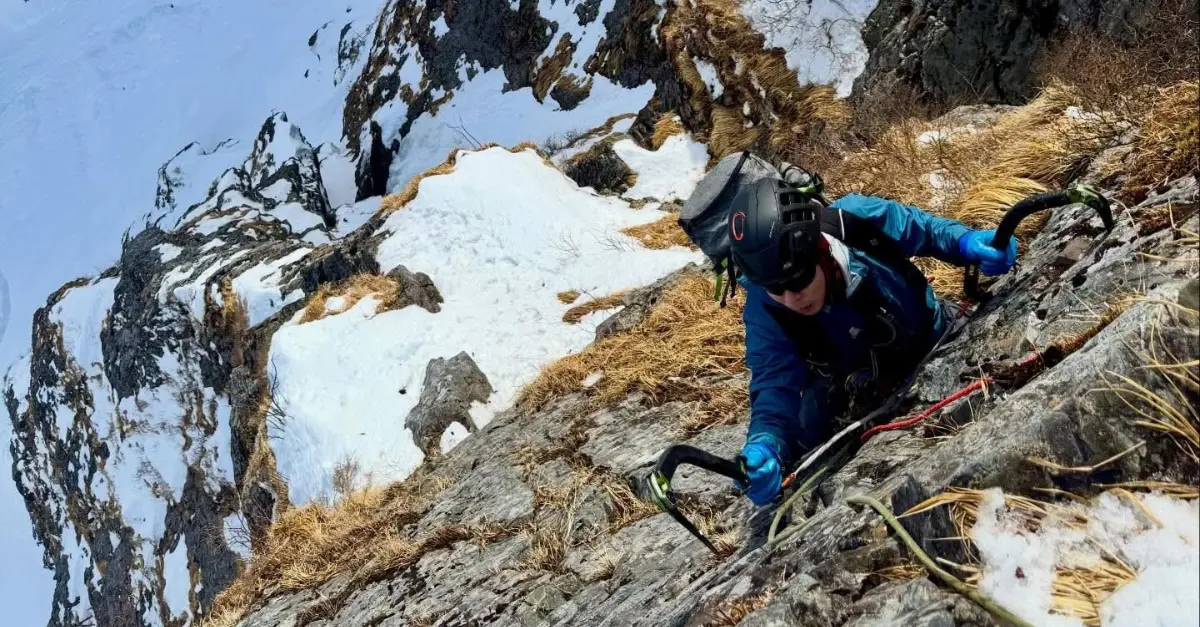
What emerges from his analysis is that it’s never the hardest pitches that cause the most trouble in winter solo climbing. A steep, technically committing 7B pitch actually brings a kind of euphoria and control. On the other hand, grade 4 or 5 terrain, choked with snow and ice, with unappealing pendulum-fall options, is often where the real danger lies. A warning he now systematically applies before every project.
The Écrins, when the rope team replaces solitude
The passage through the Écrins massif perfectly illustrates one of the most interesting traits of this trilogy: its adaptability. Charles had imagined climbing in full solo, but conditions never left enough of a weather window for such a lengthy undertaking.
Faced with an anticyclone too short for the six or seven days needed solo, he chose to rope up with his friend Antoine Boucraut on the Barre des Écrins. A change of plan that, far from being seen as a failure, became one of the most beautiful moments of the project.
A 2,000-meter avalanche
The approach to the Sélé refuge brought its share of scares. Along the way, a massive avalanche broke loose on the Pelvoux slope, likely triggered by a falling serac, sweeping down nearly 2,000 meters of elevation and generating an impressive powder cloud. The group was lucky enough to have several kilometers of flat terrain before the cloud reached them, which spared them the worst.
On the route itself, the rope team had to deal with:
pitches graded 4 and 5 made extremely time-consuming by snow and permanently worn crampons,
loose rock requiring constant improvisation to build anchors,
a final bivouac with no food, just a few hundred meters from the summit, in the cold and uncertainty,
a final sunrise Charles himself describes as truly magnificent.
This two-person ascent ultimately took four days, compared to the seven he estimates would be needed solo. Without enough supplies or gear for such a duration, the choice to rope up became obvious. And according to Charles, this partnership with a friend he’s climbed with for about ten years added an unexpected “richness” to his adventure — almost more rewarding than a solo attempt would have been.
The Pyrenees, the trilogy’s unexpected obstacle
Paradoxically, the lowest-altitude range of the trilogy turned out to be the most complicated. Arriving in the Pyrenees after six grueling days on the bike — including a twenty-hour non-stop stretch to outrun storm Gérétis — Charles found himself facing massive snowfall, ruling out any attempt on the northwest face of Pic du Midi d’Ossau or the Diamant Jaune on the Vignemale.
At the time of this account, he was therefore on standby, with the fourteen-day forecast still calling for heavy snow. The project, which he estimated at 70% complete, remained on hold, waiting for a weather window that stubbornly refused to open. It’s precisely this forced waiting that gives the story its full meaning: winter solo alpinism has nothing to do with a timed performance — it demands accepting the pace the mountain sets, even when it’s frustrating.
Why Charles Dubouloz wants to close the chapter on winter solo climbing
What makes this account particularly powerful is the clarity with which Charles talks about the coming end of this practice. He speaks about it without bitterness, almost with relief. This trilogy represents, in his mind, the closing of an entire chapter of his life as an alpinist.
He recalls a striking exchange with François Marsigny, one of the openers of Divine Providence, who had also given up soloing after several intense years, while admitting that those sensations still lingered decades later. A confession that clearly resonated with Charles, who is well aware of having “gotten a foot caught in a more or less vicious cycle.”
His professionalization as an alpinist also made this step back easier, he says. No longer depending on guiding work that would force him to work through winter allowed him to live this project without excessive pressure, and above all to openly accept today that this cycle is coming to an end. He describes an inner fire that has settled, less frustration when seeing others’ achievements, and a genuine desire to refocus on sport climbing, ice climbing, or other less physically committing forms of mountaineering.
As he puts it himself, this rugged, laborious style of alpinism should remain a phase in a life, never an end in itself. A philosophy that, in my view, could inspire plenty of outdoor athletes facing the pressure to constantly push their limits further.
FAQ about Charles Dubouloz’s winter trilogy
What are the three faces in the winter solo trilogy?
The project includes one route in the Mont Blanc massif (Divine Providence), one route in the Écrins (the Barre des Écrins, ultimately climbed as a rope team), and one route in the Pyrenees, between Pic du Midi d’Ossau and the Vignemale, still awaiting favorable conditions.
Why did Charles Dubouloz choose to climb roped up in the Écrins instead of solo?
The available weather window was too short for a solo ascent, which would have required about seven days. With his friend Antoine Boucraut, the climb was completed in four days, a compromise that allowed them to make the most of the window without jeopardizing the rest of the project.
Will Charles Dubouloz continue solo alpinism after this trilogy?
In his own words, this trilogy marks the end of his major winter solo ascents. He now wants to focus more on sport climbing and other forms of mountaineering, while remaining active in the high mountains for the rest of his life.
Hello, my name is Karim Akachar. A passionate mountaineer and Himalayan climber, and founder of the media platform Outwild, I practice mountaineering either solo or with a partner, primarily in alpine style. Through my expeditions, I share field reports, technical advice, and my mountain experience, with the aim of promoting the values of self-reliance, commitment, and respect for the alpine environment.