Rope fixers are the first to step onto the mountain, long before any client ever laces up a pair of crampons. Every spring, they are the ones who open the route through the most dangerous sections of Everest, Lhotse or Manaslu, laying the fixed lines and ladders that will later let hundreds of climbers move safely through the danger zones. Without their work, invisible to the public eye, there simply would be no Himalayan season at all. Let me take you behind the ropes, to meet the high-altitude technicians you never see in summit photos, but without whom no expedition would ever get off the ground.
Who rope fixers really are
The term can be misleading. People sometimes picture simple porters, when in reality this is an elite corps of mountaineers. In Nepal, the best-known team is the Icefall Doctors, the eight Sherpas who open the route every year through the notorious Khumbu Icefall, working under the Sagarmatha Pollution Control Committee. Their job starts as early as March in Namche Bazaar, where they go through refresher training led by the Khumbu Climbing Center before heading up to base camp.
From there, the work is methodical and brutally technical. After a traditional puja ceremony to ask the mountain for safe passage, the team begins placing ladders, ice screws, V-thread anchors and handlines that will let climbers cross crevasses and seracs. This is far from a one-off job: the ice keeps shifting constantly, so the route has to be checked and repaired almost daily for as long as climbers are using it.
A role that goes well beyond Everest
Everest may get all the media attention, but the same setup exists on Lhotse, Manaslu, Dhaulagiri and Ama Dablam. On every one of these peaks, a small team of rope fixers heads out as scouts, sometimes weeks before the first commercial expeditions even arrive. Without them, no Western guide could ever promise their clients a safe route to the top.
A tense 2026 season on the Khumbu
The spring 2026 season was a stark reminder of just how much this work shapes an entire season. A 30-metre serac, threatening to collapse in the upper part of the icefall, blocked progress for more than two weeks. Facing this unprecedented situation, authorities approved helicopter rotations normally reserved for rescue operations, so supplies could reach Camp II directly and allow work on securing the upper mountain to continue despite the standstill below.
A group of Sherpas eventually found an alternative route around the most exposed section. The path wasn’t officially opened until April 28, nearly three weeks behind the usual schedule. Hundreds of climbers stuck at base camp had to wait it out in total uncertainty while the rope-fixing teams played a game of chess against the mountain itself. That season alone explains why this job deserves more attention: a single decision made under pressure, deep in the ice, can save or wreck months of preparation for hundreds of people.
The most dangerous job in the Himalayas
We hear plenty about the risks climbers face at high altitude, far less about the risks rope fixers take on. Yet they’re the ones crossing the most unstable parts of the mountain first, sometimes several times a day. The Khumbu Icefall, for instance, usually takes a regular climber five to ten hours to cross, but the Icefall Doctors have to go back through it again and again just to keep it maintained.
Here’s what their day-to-day work actually involves:
- Scouting routes with drones before physically committing to dangerous zones
- Setting and securing aluminum ladders over crevasses that can run dozens of metres deep
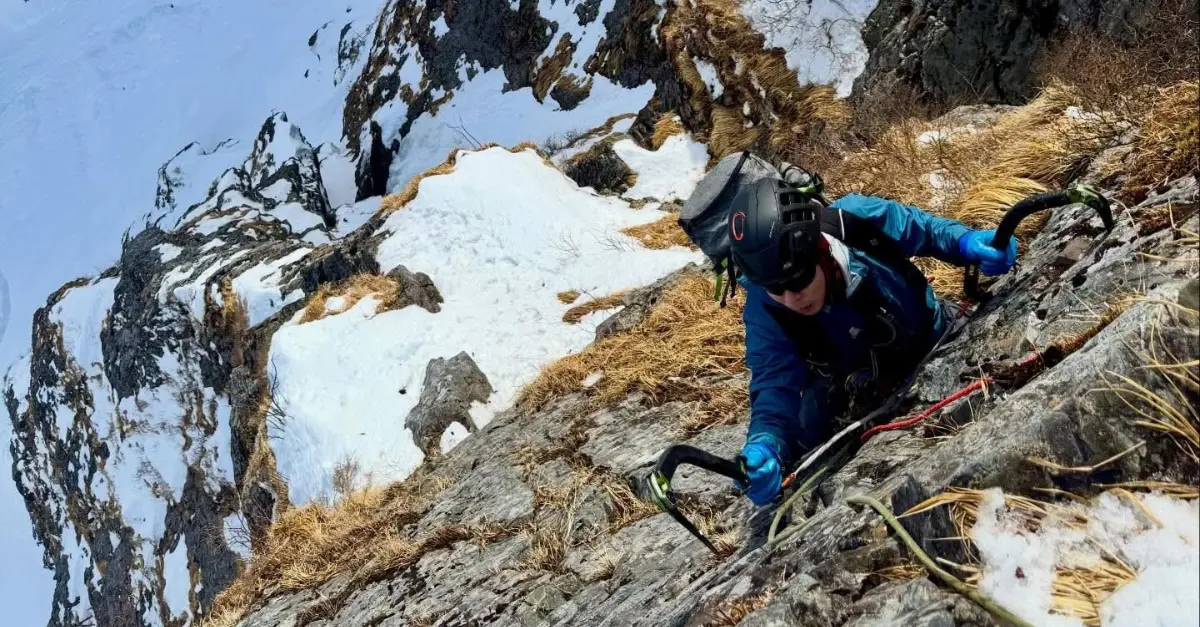
- Fixing ropes using ice screws, V-thread anchors and rock anchors depending on the terrain
- Reassessing and repairing the route daily, since the ice keeps shifting under gravity
- Coordinating high-altitude traffic with the various expedition operators on the mountain
- Responding first in case of accidents or rescues along their stretch of the route
That last point matters: statistically, rope fixers rank among the most exposed professionals in the entire Himalayan chain, well ahead of most of the clients they climb ahead of.
My own experience with these quiet heroes
I remember an acclimatization rotation at Everest base camp when I crossed paths with the team coming down after a day of fixing lines in the Icefall. No fanfare, no summit selfies, just tired faces and an almost unsettling calm about what they’d just been through. I talked for a while with one of them, who explained, matter-of-factly, how you pick a reliable anchor point in ice that’s shifting under your feet. That day, I realized that what I’d always treated as a simple logistical formality was actually the invisible backbone of the entire expedition. My opinion hasn’t changed since: these teams deserve as much recognition as speed records or oxygen-free firsts.
How they secure the route, step by step
Setting fixed ropes
Placing a fixed rope follows a precise logic. You need a solid anchor point, often a deeply screwed ice screw or a rock anchor, then a thin but strong nylon rope stretched from station to station all the way to the summit. Every climber clips into it using a belay system, like a lanyard attached to their harness, to keep moving safely even if they fall or suddenly feel the effects of altitude.
The ladders of the Khumbu Icefall
Inside the icefall, the challenge changes entirely. It’s no longer just about climbing a slope, it’s about crossing gaping crevasses using metal ladders lashed together end to end, sometimes three or four in a row, laid flat over the void. Rope fixers test their stability, adjust the tension, and come back regularly to check that the ice hasn’t shifted under the fixings — a maintenance job that never really stops for the whole season.
Why their role stays underrated
With 492 permits issued by Nepali authorities this year and hundreds of climbers converging on Everest and Lhotse, we still talk far too little about the people who make that traffic possible in the first place. American mountaineer Alan Arnette, who has tracked the Himalayan season for years on his well-known blog, regularly points out that the weather window itself depends entirely on the rope-fixing work done beforehand: without a line reaching the summit, no attempt is possible, no matter how good the forecast looks.
That invisibility probably comes down to the nature of the job itself. Rope fixers aren’t chasing the spotlight, they’re chasing a clean job and a safe walk back to base camp. Still, every recognition ceremony held in their honor, like the ones that have followed successful route openings in past seasons, is a reminder that this is a collective of seasoned professionals, not just logistical labor.
To follow how the 2026 Everest season played out, our dedicated article breaks down hour by hour how this weeks-long standstill was eventually resolved.
FAQ
Who exactly are the Icefall Doctors?
They are an elite group of highly experienced Sherpas responsible for opening and securing the most volatile and dangerous section of Mount Everest.
- Their mandate and mission: Appointed and funded by the SPCC (Sagarmatha Pollution Control Committee), this dedicated team of roughly eight mountain technicians works exclusively on the Nepalese side of the mountain. Their role is critical: they pave the way through the notorious, shifting labyrinth of the Khumbu Icefall, connecting Base Camp to Camp II (approx. 6,400 m).
- A grueling daily battle: At the dawn of every spring climbing season, they scout the moving ice to install kilometers of static safety lines and weave dozens of aluminum ladders across gaping crevasses. Throughout the entire expedition window, they patrol the route overnight to repair sections obliterated by the glacier’s relentless, downward movement.
Do rope fixers work on mountains other than Everest?
Yes, securing commercial climbing routes with fixed ropes has become the logistical standard on almost all major peaks across the Himalayas and the Karakoram.
- Scaling across the 8,000ers: Specialized teams operate on world-class peaks throughout Nepal and Pakistan, including Lhotse, Manaslu, Dhaulagiri, and K2. While these mountains do not have a permanent, standalone governing body like the “Icefall Doctors,” the hazardous work is typically managed by a consortium of expedition operators who pool their strongest climbing Sherpas.
- Adapting to technical peaks: Even on lower, highly aesthetic and steep peaks like Ama Dablam (6,812 m), specialized fixing teams pitch lines every autumn, anchoring ropes to vertical rock, mixed terrain, and pure blue ice to safeguard hundreds of commercial climbers.
Why does rope fixing sometimes fall behind schedule?
The fixing teams’ progress is entirely at the mercy of unpredictable alpine weather and the structural stability of the mountain.
- The impact of objective hazards: Heavy blizzards, high-altitude jet streams, and massive serac collapses can wipe out days of grueling work in a matter of seconds, forcing the team to retreat or forge a completely new path through the debris.
- The crunch of spring 2026: During the 2026 season, highly unstable ice conditions and relentless weather fronts delayed the official route opening by several weeks. This delay triggers a dangerous domino effect: it stalls the mandatory high-altitude acclimatization rotations for commercial clients and crams hundreds of climbers into a single, severely restricted weather window.
Can climbers thank or financially support these teams?
Yes, while they receive a standard seasonal salary, grassroots solidarity mechanisms exist to honor their exceptional risk-taking.
- Collective contributions: Most reputable expedition agencies now integrate a mandatory rope-fixing fee into their booking costs to fund equipment and base wages. At the tail end of the season, tip pools and summit bonuses are frequently collected directly from climbers to reward the crew.
- Solidarity funds: Following exceptionally brutal seasons like the one in 2026, international non-profits and local mountaineering associations organize dedicated crowdfunding campaigns. These donations supplement standard pay, feeding directly into welfare, healthcare, and educational funds for the families of Sherpas who are injured or lose their lives in the line of duty.