
Mountain satellite communication becomes essential the moment you leave marked trails and 4G coverage behind. Between Iridium and Inmarsat, the choice isn’t really about brand — it’s about physics: one runs on a constellation of low-orbit satellites that literally fly over the poles, the other relies on fixed geostationary satellites positioned above the equator. In practical terms, if you’re climbing toward a summit above 70° latitude or crossing a polar ice cap, Iridium remains the only reliable option. For a classic trek in Nepal, Patagonia, or the Alps, Inmarsat does the job just fine, often at a lower cost. Here’s everything I’ve learned testing both networks in the field, from Everest Base Camp to remote bivouacs in Kyrgyzstan.
The problem with terrestrial networks in high mountains
Past a certain point, your mobile carrier simply stops existing. No bars, no roaming, no way to call for help if something goes wrong. I experienced this very concretely on the approach to Everest Base Camp: the last village with anything resembling a signal is Namche Bazaar, and beyond that, you’re alone with the sky. In that kind of situation, satellite communication stops being a tech gadget and becomes a safety tool, on par with an ice axe or a rope.
The catch is that the market offers a dozen different brands, when in reality almost every consumer device relies on one of these two legacy networks. Understanding the difference between them completely changes how you choose your gear — and potentially your annual bill.
Iridium, the network that covers the poles and the summits
A constellation of 66 low-orbit satellites
Iridium runs on a network of 66 low Earth orbit satellites (LEO), positioned roughly 780 km above the planet and arranged across six orbital planes that cross paths above the poles. This mesh covers the entire globe, polar regions included, making it literally the only commercial satellite network that guarantees pole-to-pole coverage.
In practice, that means no matter where you stand on Earth, an Iridium satellite passes overhead every few minutes. That’s why polar expeditions, ascents above 7,000 meters in the Karakoram, or crossings of Greenland almost always rely on this network. The trade-off is that since the satellites are constantly moving, the connection can briefly hand off from one satellite to another, which sometimes requires a bit of patience to stabilize a call.
Iridium devices for adventure
Several terminals run on this network, and each one targets a different use case.
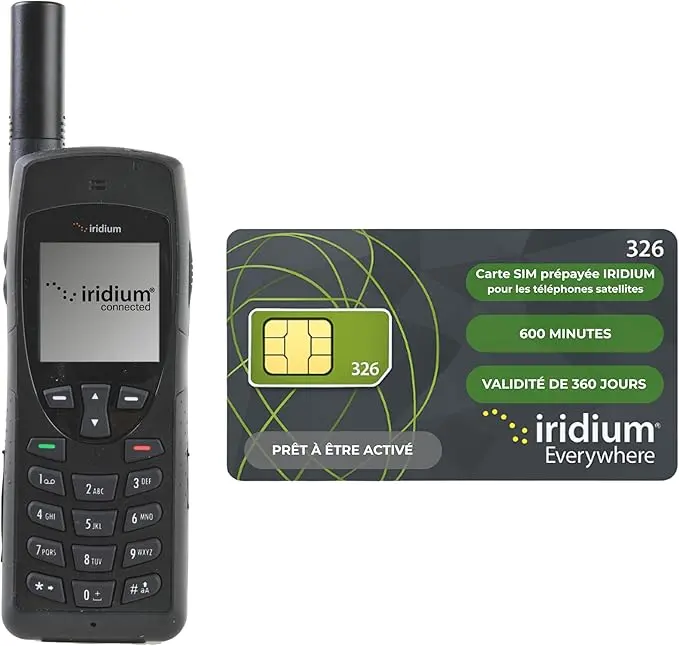
The Iridium 9555 and the more rugged Iridium Extreme are classic satellite phones — compact, built for voice and SMS, with a built-in SOS function. These are the devices I systematically pack on high-altitude expeditions, where weight and battery life matter more than data speed.
The Iridium GO! and its newer version, the Iridium GO! exec, work differently: they’re satellite hotspots that turn your smartphone into a satellite phone over Wi-Fi. The Iridium GO! exec runs on the Iridium Certus 100 service and offers Wi-Fi connectivity for messaging, social media, weather, and light web browsing, on top of handling two simultaneous voice lines with solid quality. Data speeds can reach up to 88 kbps — enough for emails or WhatsApp messages, but clearly not for streaming.
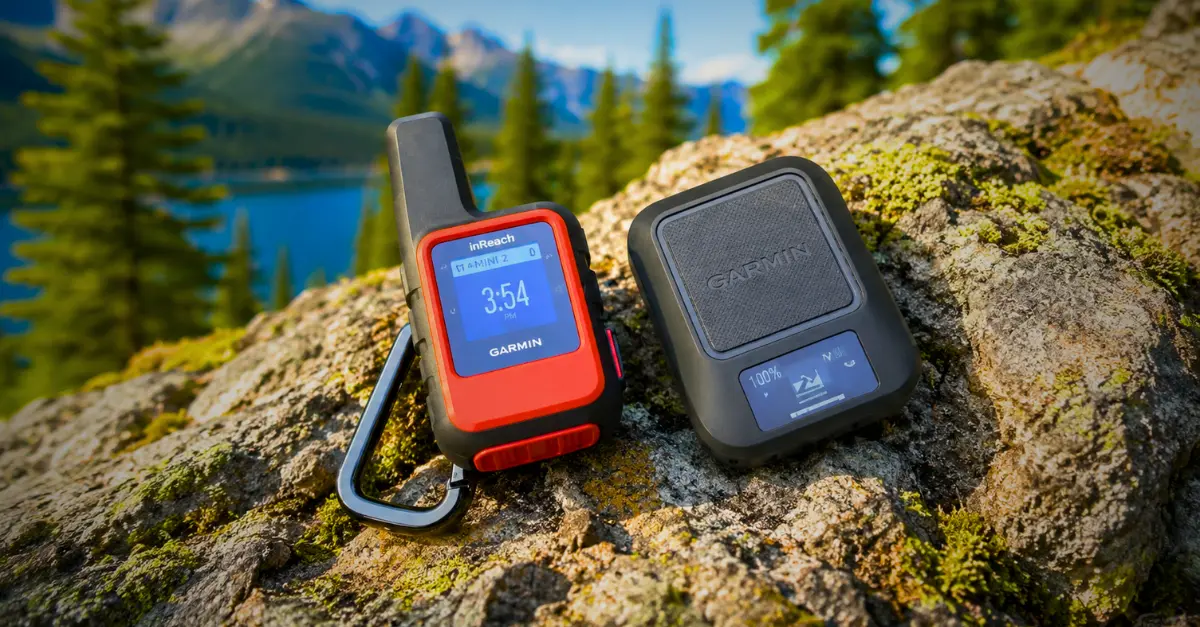
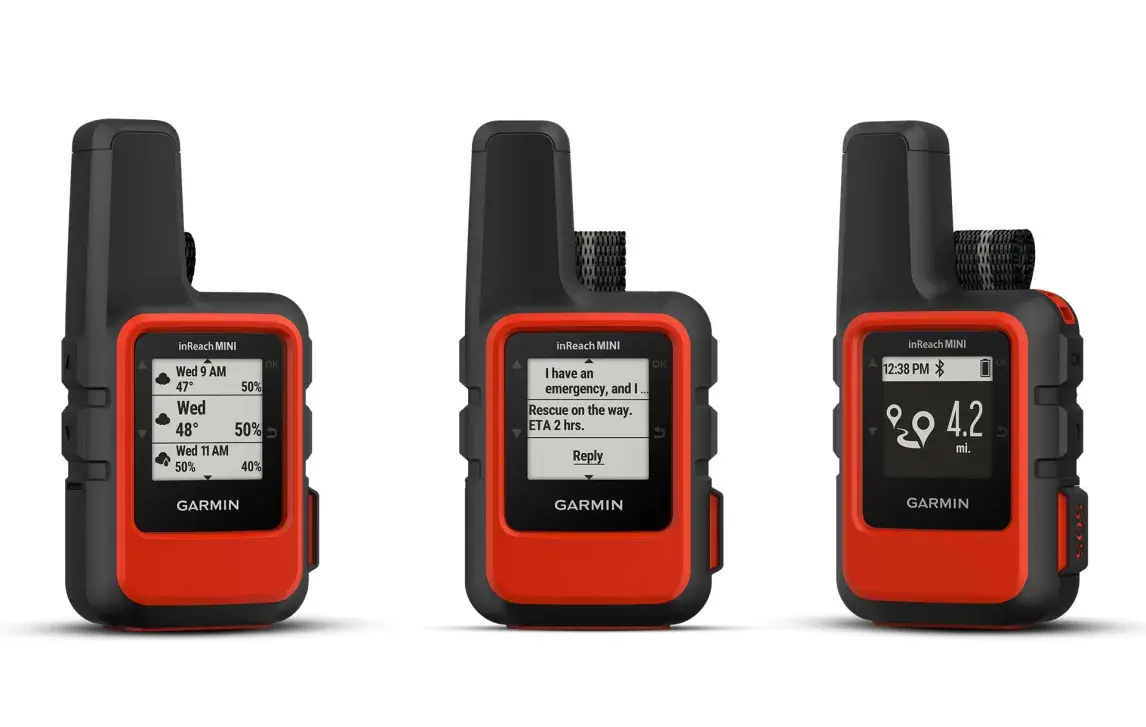
I’ve heard high-altitude guides on Denali describe always keeping an Iridium GO! in their pack for tactical decisions at altitude, even while relying on a Garmin inReach Mini for lighter outings — a device widely seen as a versatile tool despite its weight, capable of combining voice calls, messages with a generous character limit, and limited web access. That’s exactly the trade-off I find in my own expeditions: a compact, lightweight device for everyday use, and a more complete terminal when the logistics allow for it.
For safety, Iridium offers around-the-clock assistance, with an emergency response coordination center available 24/7 once the device is registered — which is enormously reassuring when you’re above 6,000 meters and the weather turns.
Inmarsat, geostationary reliability
Four fixed satellites, near-global coverage
Inmarsat, now operated under the Viasat umbrella, works on a completely different principle. The network relies on four satellites placed in geostationary orbit around the Earth, roughly 36,000 km up, each fixed above a specific region of the globe. This GEO technology offers the advantage of a stable connection once established, unlike Iridium’s moving satellites: no need to move to keep the signal, which cuts down on dropped calls.
The logical trade-off of this system is that no geostationary satellite can cover the poles, since they orbit above the equator. The Viasat L-band network covers up to 99.9% of the globe, excluding the most extreme polar latitudes. For 95% of outdoor projects — a trek in Peru, an Andean expedition, a desert crossing in Morocco — that limitation has essentially no practical impact.
The IsatPhone 2, simplicity and battery life
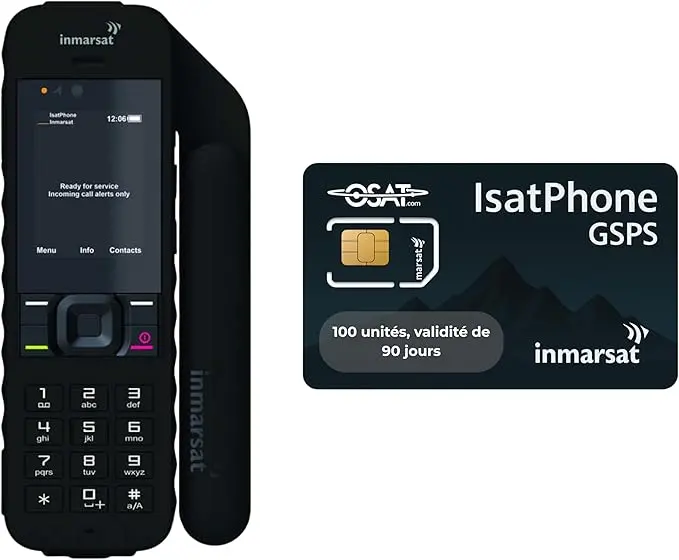
The flagship terminal remains the IsatPhone 2, a rugged satellite phone built to last in the field. It delivers up to 8 hours of active talk time and 160 hours on standby, making it one of the longest-lasting devices on the market, far ahead of most hybrid satellite smartphones. It operates between -20°C and +55°C with humidity resistance up to 95%, and connects to the network in under 45 seconds once the antenna is extended skyward.
On the safety side, the IsatPhone 2 includes built-in access to GEOS emergency assistance, triggered with a single press of a dedicated button that sends your GPS position to the response center, available 24/7. It’s a system comparable to Iridium’s in how it functions, even if the organization behind it differs.
I particularly like this device for expeditions where pack weight matters as much as reliability: it’s a simple, no-frills handset that does exactly what’s asked of it without unnecessary complexity.
Iridium vs Inmarsat, the real differences in the field
Rather than drowning you in spec sheets, here’s what actually matters when you’re on a glacier or in a remote valley:
- Polar coverage: Iridium only. Inmarsat covers nearly everything except the extreme northern and southern latitudes.
- Connection stability: advantage Inmarsat, thanks to fixed geostationary satellites that avoid the micro-dropouts caused by satellite handoffs.
- Connection speed: advantage Inmarsat, with generally faster pairing once the antenna is correctly aimed south.
- Versatility of use: advantage Iridium, especially with the GO! exec, which adds email, messaging, and light browsing on top of voice.
- Battery life: advantage Inmarsat with the IsatPhone 2 and its 160 hours of standby, especially valuable on a long expedition.
- Overall cost: Inmarsat tends to be more affordable, both for the terminal price and the plans.
- SOS reliability: roughly equivalent for both, with dedicated emergency centers operating around the clock.
Neither network is objectively “better” — it all comes down to where you’re headed and what you prioritize.
My personal experience at Everest Base Camp
On my own expedition to Everest Base Camp, I brought an Iridium terminal, more out of habit than technical necessity — the region obviously isn’t polar. But at high altitude in the Himalayas, the terrain blocks a huge amount of sky, and I found that Iridium’s dense satellite network made it easier to lock a signal in steep, narrow valleys where the visible horizon is extremely limited.
What I take away most from that experience is the importance of testing your device before you leave, ideally under similar conditions. Many trekkers only discover their satellite gear once they’re already on the trail, panic when they can’t get a signal, when a simple antenna positioning issue or a missed firmware update explains 90% of the problems people run into. My honest advice: take the time to make a test call and send a location ping from your own backyard before departure.
Which device to choose for your project
For a classic trek or a non-polar expedition
If your route stays between the tropics and the temperate high latitudes — the Himalayas, the Andes, the Alps, the Atlas Mountains, Kyrgyzstan — an Inmarsat IsatPhone 2 terminal is more than enough. You get excellent battery life, a gentler entry price, and reliability proven over decades of maritime and humanitarian use.
For an extreme high-altitude or polar expedition
Beyond 70° latitude, on an ice cap, at sea during an ocean crossing, or on an Arctic or Antarctic expedition, Iridium becomes the only viable choice. It’s also the network I’d recommend if you want a versatile device offering email and messaging on top of voice, via the GO! exec.
The real cost of mountain satellite communication
Budget varies enormously depending on how you use it. An Iridium GO! costs around $855 to purchase, not counting the monthly subscription and out-of-plan minutes. On the Inmarsat side, the IsatPhone 2 is generally positioned in a more affordable price bracket, with prepaid or monthly plans suited to occasional adventure use rather than heavy professional usage.
My practical advice: never calculate your budget based on the device price alone. Out-of-plan communications, especially calls between the two networks, can quickly drive up your bill. Choose a plan with a number of minutes or MB that genuinely matches the length of your expedition, rather than an oversized annual subscription.
Frequently asked questions
Does Iridium really work everywhere, even on the summit of Everest?
Yes, the Iridium constellation is the only one offering absolute global coverage, including on the most remote summits on the planet.
- The strength of low orbit: Unlike other networks, Iridium relies on a fleet of more than 60 satellites moving in low Earth orbit (LEO) along polar tracks. This orbital geometry guarantees that at least one satellite passes overhead at any given time, no matter where you are on the globe, Himalayan summits included.
- The constraint of terrain: For the connection to establish, your terminal simply needs a direct, unobstructed view of the sky. At the summit of Everest (8,848 m), the horizon is completely open, which guarantees excellent signal quality, while the bottom of certain extremely steep gorges can sometimes delay the connection until a satellite passes over the gap.
Can Inmarsat be used in the high mountains of the Alps?
Absolutely, the Inmarsat network is fully operational across the entire Alpine range.
- Geostationary technology: Inmarsat uses high-altitude geostationary satellites (GEO) positioned above the equator. Since the Alps sit at mid-latitudes (around 45° North), the satellites remain high enough above the horizon to provide stable, strong coverage across all of Central Europe.
- The orientation factor: Since the signal comes from the south, the only real technical constraint in the high Alpine mountains is the “shadowing” effect of the terrain. If you’re standing at the base of a very steep north-facing granite wall, the rock can temporarily block the signal coming from the equator. Simply moving a few meters or reaching a ledge or ridgeline is usually enough to instantly restore an optimal satellite link.
Which satellite device should I choose for a first solo trek?
For a first experience traveling beyond standard mobile networks, the Inmarsat IsatPhone 2 stands out as a reassuring go-to choice.
- An attractive value for money: The IsatPhone 2 stands out for its lower upfront cost and generally more affordable prepaid top-up options compared to its Iridium equivalents, making it an ideal investment for hikers just starting out with off-grid autonomy.
- Reliability built for the field: This satellite phone offers a very intuitive handling experience, similar to a regular mobile phone, paired with a rugged casing resistant to shocks and water splashes (IP65 rating). It also boasts one of the best battery lives on the market (up to 8 hours of talk time and 160 hours on standby) and includes a dedicated SOS assistance button to alert rescue services in case of a genuine emergency on the trail.
Can you call an Iridium phone from an Inmarsat device?
Yes, direct calls between competing satellite networks are technically possible, but they follow specific pricing rules.
- Technical interoperability: There’s no hardware barrier to reaching an Iridium terminal from an Inmarsat handset (and vice versa). You simply dial the international prefix specific to each network (such as +8816 for Iridium or +870 for Inmarsat) followed by the device’s number.
- Out-of-plan billing: These so-called “inter-satellite” links bypass traditional terrestrial infrastructure, which generates extremely high interconnection fees. These call minutes are never included in standard monthly plans or prepaid cards from either provider. The caller is charged a very steep per-minute rate (often three to four times higher than a call to a regular mobile number); a more economical alternative is to use free internet-based text messaging portals to send short SMS messages between terminals.