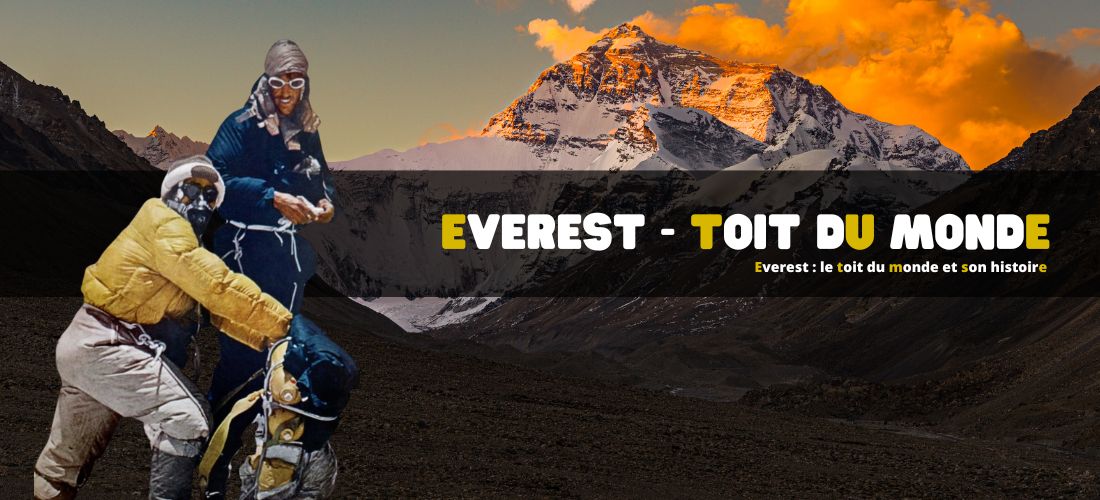
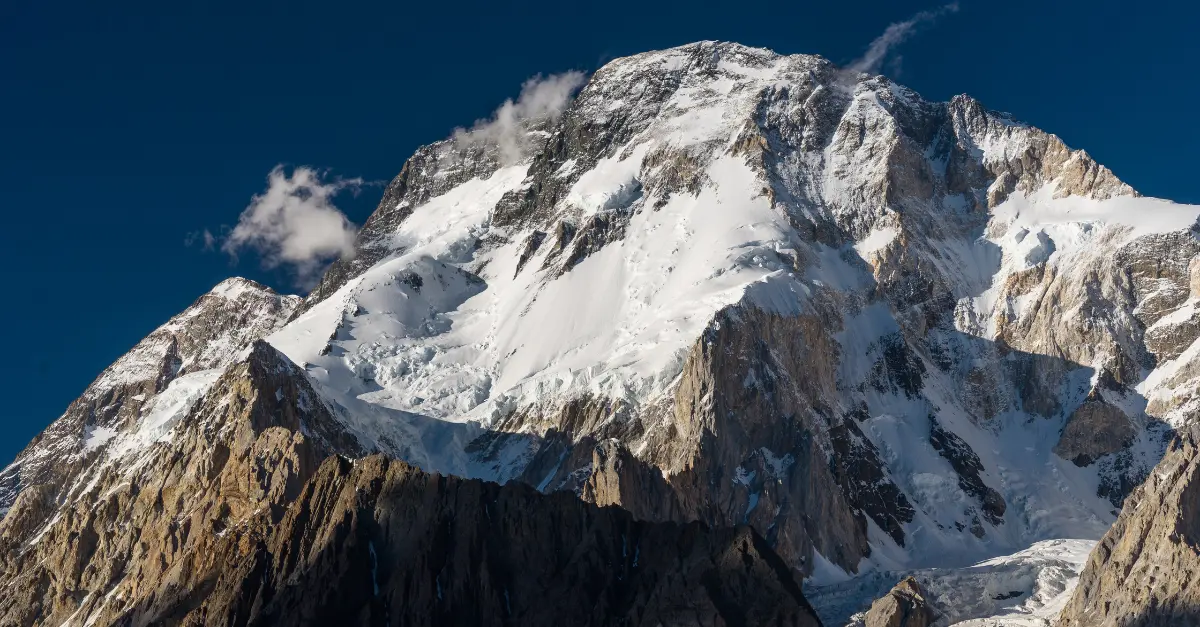
Mount Everest, located in the Himalayan range, is without doubt the most mythical and coveted mountain in the world. It is a legendary peak that fascinates, inspires and frightens in equal measure. Since Sir Edmund Hillary and Tenzing Norgay first climbed it on 29 May 1953, the “roof of the world” has drawn thousands of mountaineers and adventurers every year. But far beyond that feat, Everest represents much more than a simple sporting challenge. It is a place steeped in history, myths and tragedies. This mountain is not only the highest on the planet — it is also the stage for great human victories, numerous disasters and a growing reflection on the ecological impact of human activity.
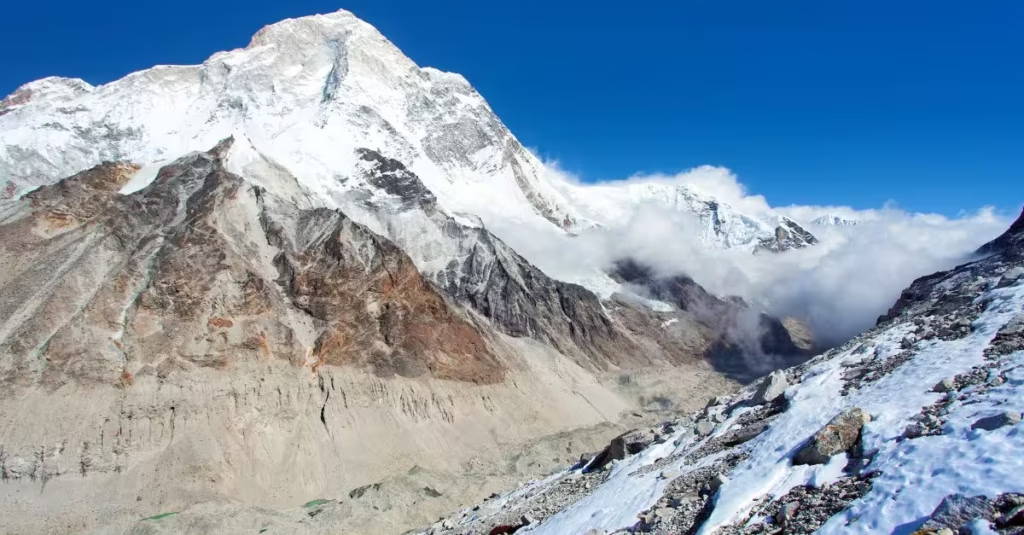
Situated on the border between Nepal and Tibet, Mount Everest reaches 8,848.86 metres, an altitude revised in 2020 following measurements carried out by Nepalese and Chinese authorities. It forms part of the Himalayan range, which stretches over 2,400 kilometres across five countries: Bhutan, China, India, Nepal and Pakistan. Mount Everest is known by two names: in Nepali it is called “Sagarmatha”, meaning “forehead of the sky”, and in Tibetan it is named “Chomolungma”, meaning “goddess mother of mountains”.
The approach to Everest generally depends on which side of the mountain the ascent is attempted from. On the Nepalese side, the South Base Camp sits at around 5,364 metres above sea level, and this is the route most commonly used by climbers. The approach typically begins in Lukla, a small village where mountaineers land after a short but treacherous flight from Kathmandu. From there begins a long acclimatisation trek through the Khumbu Valley, a region rich in history and culture, home to the Sherpas — seasoned mountain people who accompany expeditions towards the summit.
Sir George Everest and Chomolungma: the story behind Everest’s first name
Everest has not always gone by that name. Before being christened in 1865 by British colonial administrators, it was already known to local populations by various names. The name “Everest” was given in honour of Sir George Everest, a British geographer and Surveyor General who worked on the Great Trigonometrical Survey of India. Ironically, however, Sir George Everest himself never set eyes on the mountain.
The Tibetans and Nepalese had named it long before the British arrived. As mentioned above, the Tibetans called it “Chomolungma”, a name that reflects the sacred dimension of the mountain in Tibetan culture. For them, Everest was not merely a geological formation, but a deity. The British, in pursuit of precise cartography and territorial dominance, gave it Sir Everest’s name, thereby erasing part of the local memory connected to the summit.
The relentless British: the long road to conquering Everest
Long before 1953, the idea of climbing the world’s highest peak already haunted the minds of many Western explorers. From the early twentieth century, several British expeditions had attempted to conquer Everest, often without success and sometimes at the cost of human lives. One of the first notable attempts took place in 1921, led by Briton Charles Howard-Bury. It was an exploratory expedition that did not aim for the summit but rather sought to survey the mountain’s approach routes.
In 1922, a new expedition led by George Mallory and Edward Norton attempted the ascent via the northern face in Tibet. They reached an altitude of 8,320 metres, marking the first time human beings had ever climbed to such a height. The expedition nonetheless ended in failure. In 1924, George Mallory and Andrew Irvine tried again, but disappeared mysteriously. Mallory’s body was not found until 1999, leaving open the question of whether the two men had reached the summit before perishing.
The following decades saw a succession of expeditions — the vast majority British — that failed to overcome the technical difficulties, extreme weather conditions and lack of adequate equipment. It was not until 1953 that the British dream was finally realised.
1953: the conquest of Everest
The year 1953 marked a decisive turning point in the history of mountaineering. After several years of failure, a British expedition led by John Hunt finally succeeded in conquering Everest. On 29 May 1953, Sir Edmund Hillary, a New Zealand beekeeper, and Tenzing Norgay, a Nepalese Sherpa, became the first men to set foot on the roof of the world.
The success of this expedition is often attributed to better preparation, more sophisticated equipment and a more effective use of bottled oxygen. But one must not overlook the immense role played by Tenzing Norgay, whose experience as a Sherpa and intimate knowledge of the mountain proved decisive assets. Their ascent remains, to this day, one of the greatest human achievements — a symbol of determination, courage and cooperation between men of different cultures.
Hillary and Tenzing: a friendship forged at the summit
While Hillary and Tenzing’s feat is today widely celebrated, it is important to highlight the particular bond that united these two men. Before their historic ascent, Hillary and Tenzing had already worked together on previous Himalayan expeditions, and a deep friendship had grown between them. Their collaboration on Everest was not merely a matter of strategy or technique, but also a testament to mutual respect.
Tenzing Norgay became a true icon across Asia, while Hillary was welcomed home as a hero in New Zealand. Together, they made history in mountaineering, and their achievement remains an example of unity that transcends cultural boundaries.
Everest’s clients: the view of Philippe Grenier
With Everest’s growing popularity, the summit has become accessible to amateur climbers — often inexperienced but with considerable financial means to fund an expedition. Philippe Grenier, a high-altitude guide and specialist in Himalayan expeditions, shares his perspective on this evolution.
According to Grenier, Everest has become a prestige destination for many “extreme tourists”, willing to spend considerable sums for a place on a commercial expedition. He notes that these climbers, though accompanied by experienced guides, frequently underestimate the dangers the ascent entails. Unpredictable weather conditions, oxygen deprivation and extreme fatigue are all factors that can turn an expedition into a tragedy.
Furthermore, Grenier criticises the lack of preparation among certain climbers who, in some cases, have never scaled any significant summit before attempting Everest. This trend not only increases the risk of accidents but also overcrowds the ascent routes, creating dangerous bottlenecks above 8,000 metres in the infamous “death zone”.
Everest and records
Since 1953, Everest has been the scene of many impressive feats and records. One of the most notable is undoubtedly that of Jordan Romero, a young American who became, in 2010, the youngest person to reach the summit of Mount Everest at just 13 years of age. Other records include the greatest number of successful ascents, held by Sherpa Kami Rita, who has climbed Everest more than 25 times.
Another celebrated record is that of Reinhold Messner, the legendary Italian mountaineer who in 1980 became the first person to complete a solo ascent of Everest without supplemental oxygen. This feat remains one of the most remarkable in the history of mountaineering, as it demonstrated that even the world’s highest summits can be climbed under extreme conditions, without artificial assistance.
Jean Afanassieff: the first Frenchman on the roof of the world
France has also left its mark on the history of Everest mountaineering through Jean Afanassieff, who became the first French person to reach the summit in 1978. A talented climber and pioneer of Alpine climbing, Afanassieff took part in a French expedition led by Pierre Mazeaud. The ascent was a landmark moment for the French climbing community and made Afanassieff an iconic figure in the sport.
Jean-Michel Asselin and the fiftieth anniversary of Everest
On the occasion of the fiftieth anniversary of the first ascent of Everest, Jean-Michel Asselin, journalist and mountaineer, conducted an interview to mark this historic event. In his account, Asselin reflects on the enduring fascination that Everest still holds, even after so many years. He also touches on the changes that have taken place since 1953, both in terms of equipment and mindset. Mountaineering is now accessible to a greater number of people, but this democratisation of the mountains also raises many ethical and ecological questions.
Contemporary challenges
Beyond human achievements, Everest also mirrors the environmental challenges facing the modern world. Due to the ever-increasing flow of climbers, the mountain has become a site of pollution. The waste left by mountaineers — from oxygen canisters to abandoned tents — accumulates on Everest’s slopes, turning this sacred mountain into an open-air rubbish dump.
Many initiatives have been launched to clean up the mountain, and litter-collection expeditions are organised on a regular basis. However, the problem persists, underscoring the difficulties of reconciling mass tourism with environmental protection in places as sensitive as the Himalayas.
In closing…
Mount Everest, far more than a simple summit, is a living legend. It embodies both humanity’s conquest of nature and the dangers that nature can inflict in return. It is a mountain that symbolises at once the greatest human victories and the most terrible tragedies. While Everest continues to attract climbers and adventurers from around the world, it has also become a symbol of ecological stakes and of humanity’s responsibilities towards the natural world.
Where the challenges of the past centred on the simple conquest of the summit, those of today concern the preservation of this fragile environment — so that future generations may still stand in awe before this roof of the world.
Hello, my name is Karim Akachar. A passionate mountaineer and Himalayan climber, and founder of the media platform Outwild, I practice mountaineering either solo or with a partner, primarily in alpine style. Through my expeditions, I share field reports, technical advice, and my mountain experience, with the aim of promoting the values of self-reliance, commitment, and respect for the alpine environment.